A simple way to build the class routine: where to start, where it goes wrong
Building the class routine takes days, and a teacher still ends up in two classes at once. A step-by-step method, and how to avoid the usual mistakes.
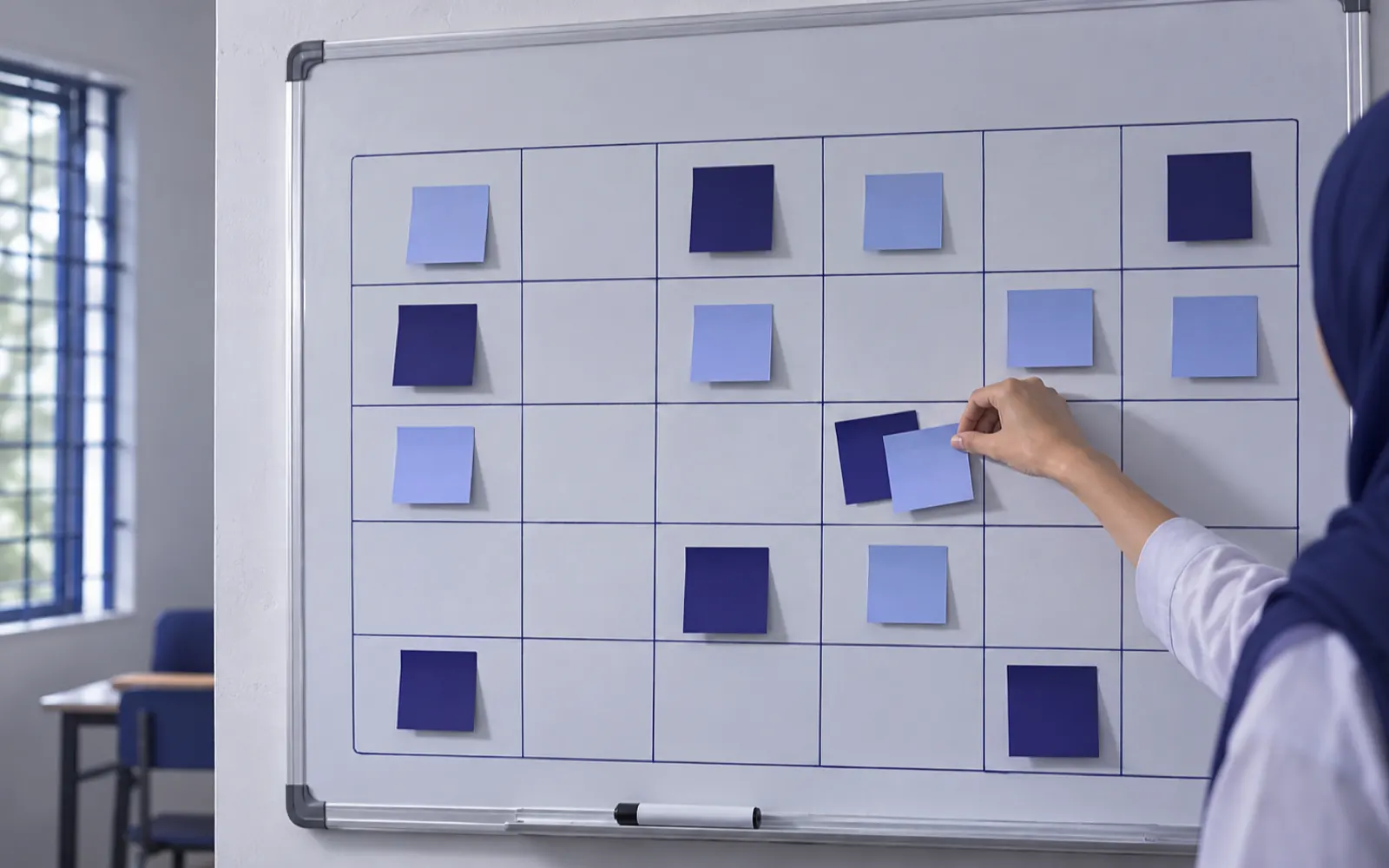
At the start of a new year, in almost every institution, a senior teacher spends several days building the routine on a large sheet of paper. The sheet fills with crossings-out. Then in the very first week it turns out that one teacher is in two classes in the third period on Thursday. One subject has three periods a week instead of four. And one teacher has seven classes a day while another has three.
Building a routine is hard because many conditions have to fit together at once. But working in a fixed order makes it much easier. This post sets out that order.
Make four lists before you start
Before you touch the routine grid, keep these four lists at hand. Start without them and you will have to stop again and again halfway.
- Classes and sections: how many sections each class has.
- Subjects and weekly periods: how many periods a week each subject gets in each class. For example, in Class Six, Mathematics six a week, Arts and Crafts two.
- Who teaches what: the teacher of every subject in every class.
- Rooms: especially the ones several classes share, such as the science lab and the computer room.
Put the second and third lists together and check how many periods a week each teacher ends up with. If someone has far too many, share the work out before building the routine. Fixing it later means moving the whole routine around.
Settle the shape of the day first
Next, settle the shape of the day: when the institution starts and ends, how many minutes each period is, and when and how long the breaks are. The work is easiest when this shape is the same for every class.
Settle the weekly holiday in advance too. If Thursday is a half day, it will have fewer periods; write that down at the start.
Place the hard parts first

The biggest mistake in a routine is filling the easy boxes first. Then there is no room left at the end for the hard parts. So place them in this order:
- The person with the least free time: a teacher who teaches many classes, or a part-time teacher who comes only on certain days. Place their periods first.
- Shared rooms: the classes in the science lab or the computer room.
- Double periods: those that need two periods in a row, such as practical classes.
- The remaining subjects: last.
Where you can, keep demanding subjects such as Mathematics or English early in the day, while students are fresh. It is better if the same subject does not come twice on one day.
Get one day right, then copy it to the others
In almost every institution most days of the week run alike, with only a few periods changing. So first get one day completely right. Then copy it to the other days and change only what is different. It takes less than half the time.
The same goes for several sections. Get one section's week right, copy it to the others, then change the teachers.
Check three things at the end
When the routine looks finished, check three things before printing:
- Clashes: whether a teacher or a room is in two places at the same time.
- Weekly periods: whether every subject has as many periods a week as it should.
- Teacher load: whether anyone has too many periods in a day, or five classes in a row.
In the first week, ask teachers for feedback. Small problems are easy to fix in the first week.
Get the routine into everyone's hands
A routine that stays only on the office wall is half done. Put each class's routine on that classroom's wall, the whole routine by day in the teachers' room, and give every teacher their own weekly routine. Make sure students and guardians can see their own class's routine too.
When the times change in Ramadan or in exam week, make a separate routine. Editing the main routine makes it hard to go back to how it was.
Need a clean, printed routine today? The free class routine maker lays the periods out as a grid in your browser, ready to print or save as a PDF.
Building the routine in EduSine
In EduSine the class routine is built from Academic → Routines in the menu. The software helps at almost every step of the method above:
- Press Create New Routine and give the start and end of the school day and the period length, and it works out how many periods there will be.
- A separate routine by date can be made for particular days, such as Ramadan or exam week.
- While you place a period, every teacher and room shows whether they are free or busy at that time. If you place a busy teacher, the period is not saved.
- A tiffin or prayer break can be added to every class at once.
- One day's routine can be copied to other days, and one section's week to other sections. Anything not copied is listed with the reason.
- Under the grid you see the number of clashes, the busiest teacher, and how many periods each subject gets a week. Any teacher's weekly routine can be printed on its own.
- The routine can be downloaded class-wise or day-wise as PDF, Excel, CSV or an image (PNG).
- You can show the routine on the institution's website. On the Standard plan, every student and guardian sees their own class and section's routine in the portal.
To see it step by step, read the Class routine tutorial. If you want to write rooms in the routine, first add them under Buildings and rooms.
A few details are all it takes to start your institution's website and software, free.
Create your website for freeRead next

12 questions to ask before you choose school management software
Before you pay for any school software, ask these questions about language, mobile use, board rules, the full cost, data safety and support.
5 min read

Excel or school software: which one, and when
How far registers and Excel can take an institution, where the trouble starts, and what to check before moving to software. An honest comparison.
4 min read

A guide to a fair admission lottery
When applications outnumber seats, a lottery is the simplest way. Announcing the rules first, drawing in public, running the waiting list and avoiding complaints.
5 min read